So, I'm not on this blog much. Or blogging much at all, neither here or on my main blog. I've been running some Advanced Fighting Fantasy 2e - The Warlock of Firetop Mountain no less - using my Viscera! booklet to add some grim peril to the adventure. But I am perpetually stricken by bouts of gamer ADD - and while running one game I am fantasising about running another. A stack builds. Or rather stacks build, of books that I've pulled from my shelves with half a mind to making *that* my next campaign. Currently my stack is filled with BRP/d100 games (the elegance and ease with which d100 games run, and are comprehended by casual players attracts), OSR bits and bobs (there is so much creativity in OSR communities), and Fate games (I really want to 'grok' this approach to playing). But always, always wedged in those stacks is a WFRP1e or 2e book, a game that has a tight hold on my imagination. If anyone is interested, most usually it is the WFRP1e rulebook, or the 2e Career Compendium (which sparks off all kinds of sandboxy adventure ideas).
That's by-the-by, really. What I have logged into say is that the Prince of Nothing has produced an exhaustive, multi-part review of WFRP1e (in anticipation of Zweihander). Even warts-and-all reviews of WFRP1e remind me of what I'm missing!
Thanks to Strike to Stun* I have stumbled across a fantastic new-ish WFRP blog - Awesome Lies, by Gideon. I have been enjoying his WFRP Manifesto series, which looks at the history and design of WFRP1e, but it is also the home of his excellent The Enemy Within Companion, and a new document that sounds absolutely up my street - a conversion of Night's Dark Terror (original available here) to WFRP1e.
Hello, is anyone still here? Here, I teach Gradma to suck eggs.
Over on my other blog, I wrote a post titled Skills as Saving Throws. A much shorter version of the post is this:
I have, in the past, run skill based RPGs in an unsatisfactory way. Some of this is prompted by poor refereeing advice in published adventures, and some by the temptation to ask for a dice roll as if the players rolling is the game, rather than the players making choices.
Recently, I have taken to using an 'old-school' approach; treating skill tests as Saving Throws. I am no longer treating them as rolls to accomplish, but rolls made to avoid failure when failure would otherwise occur. In trad. D&D, you don't avoid traps etc. way of Saving Throw, by rolling dice. You avoid traps by clever play, good (or fortuitous) choices, and only when you have stepped on the trigger do you roll to Save.
This relates to WFRP because WFRP is exactly one of the games that I have refereed poorly in the past. I have been unable to find the blog post in which someone wrote of the mistakes that they made when running Shadows Over Bogehafen, but I'll sum it up the source of much of his dissatisfaction - asking for Fel tests for ordinary interactions and the attendant frustration and failure. WFRP is often accused of being a system in which PCs are incompetent, with starting characteristics around the 30% mark.
The way round this is not to make a whole load of Skill Tests 'Easy' or 'Mundane', applying modifiers as a matter of course. The way round this is to not roll dice at all, at least most of the time. Most actions that a Player might have their PC accomplish don't need a dice roll, if the PCs have the required skills/background and have chosen suitable courses of action. In an idealised old-school game (see Matt Finch's Primer), the play is in the talk over the table and the choices the players make on behalf of their PCs. When the dice come out, something bad is about to happen - in these kinds of gritty, lethal games, combat is the key example.
Combat is always rolling to 'save', in circumstances in which conditions are such that failure is likely. In combat, the referee is provided with mechanics for determining the consequences of failure. For most skill tests, the referee has the responsibility of determining the consequences of a failed skill test. That a trained person might 'fails' 70% of the time in such circumstances should be always borne in mind when considering the consequences as well as whether to call for a skill test at all.
I don't see any reason why in most cases, where a player chooses a course of action that will require a skill test, the referee cannot make the (likely? possible?) consequences of failure plain before the choice is finalised. I've been trying to do this, and I feel it leads to better play, on the part of both the players and, importantly, the referee. It certainly has helped me avoid both the 'unchosen skill test' that is all too present in published scenarios, in which a passage of play is not a series of choices, but a series of dice rolls, as well as the inconsequential skill test, in which a failed skill test carries no cost, as an NPC or other referee-devised contingency steps in to fill in the gap.
So, I prefer to think of skills (which are all or nothing affairs in WFRP) as being 'permissions' for certain actions to be taken, or to be taken without a dice roll at all, and the percentages to be the equivalent to 'saving throws' to prevent everything going very badly wrong.
Incidentally, a BECMI 'Normal Man' has Saving Throws in the 14-17 range, which roughly amounts to a 30% chance of success.
p.s. Thinking of skill tests as 'rolls to save' rather than 'rolls to accomplish' doesn't quite capture all circumstances. But I feel that most occasions in which it is difficult to conceive of the skill test as anything other than a 'roll to accomplish' - for example, when searching for information in the Library of Verena - can be dealt with by looking at skills such as Animal Training, or the Dark Heresy system, in which, roughly speaking, failed skill tests cost time. And if time is of no consequence, neither then is the skill test. These type of skill tests should be conceptualized quite differently to 'rolls to save', and one way to ensure that this is done is by being as explicit as possible about the consequences of failure.
I once had players generate new characters and each one
ended up with the Dance skill. They could earn more money as a dance troupe,
busking on the streets of Nuln, than they could by engaging in the kind of
dirt-grubbing adventures that starting WFRP characters often find themselves.
And the GCs they’d collect by dancing in the street would far outstrip anything
they could hope to earn from steady employment.
Musicless Dancing in the Street
At least, that is how I remember it. But is it true?
First, let’s consider player character subsistence. A
character who can afford it must spend 7/- per day on food, though he or she
could stave off starvation by spending as little as 3/-. There are, of
course(!) 8 days in an Imperial week. This means that characters ought to be
spending 56/- a week on food (a minimum of 24/-). A bed in the common room of
an inn would set them back another 24/-, giving us a weekly subsistence of 80/-,
or 4 GCs, per week. Or, if our character foregoes the bed (spending just 16/-
on floor space) and eats very badly, 40/- (2GCs).
What can a player character earn in a ‘steady’ job? 60/- (3GCs) per
week as an artisan, 30/- (1GC 10/-) as an entertainer, 42/- (2GCs 2/-) as a labourer, and just 3/-
per week as a servant, though free board and lodgings in provided in that case.
I know the Old World is grim and perilous, and life for the working classes isn’t
bread and roses, but we must presume that the subsistence costs given above are
for itinerant adventurers. It would, of course, be very expensive living in
even the cheapest hotel and eating out for every meal. An entertainer must be able to survive on 30/- a week,
even if they can’t live well, and an artisan must have an appreciably better
standard of living. We can assume that a character with a ‘permanent’ home and
preparing his or her own food can get by at the wage rates listed. Still, there
isn’t much money to be made is honest labour. And that is if the character can
find work – finding these jobs is subject to an Employment test!*
But what about busking? A busking character makes a test
against Fellowship every hour. Success = D4+1 GCs (average 3.5 GCs), failure =
D6 shillings (average 3.5/-), and a failure by more than 30% = trouble. Let’s
say that a character busks for 5 hours every day, for a total of 40 hours
busking a week. Let’s also say that the busking character has a Fel of 30%, the
average for a starting character. Having a skill such as Dance allows the
character a +10% bonus to Busk tests. So, over 40 hours busking a character
will have 16 successful hours, 12 unsuccessful hours, and 12 hours being
hassled by rowdy locals, moved on by watchmen, etc. If the character can stand
the 12 hours of ‘trouble’, he or she will collect an average of 56GC (over the
good hours) and 42/- (the bad hours). Or 58GCs 2/-!
Oh, the trouble? These are player characters we are talking
about. If they have survived even the introductory adventure they will have
killed a handful of cultists and a demonic monster! Rowdy locals? Watchmen?
Worth the hassle for nearly 60GCs a week.
So I wasn’t misremembering. And that is why players in my
games spent a lot of the time busking, and very little adventuring.
*It does appear that these wage rates are for a 6 day working week, with the authors forgetting that they had made the Imperial week 8 days long. But, even adding an extra day's wages...
Suffice to say, I think he's got a point, but what does this have to do with Warhammer? Well, Ed's observation has been made at a particularly opportune time, as Banksy opens Dismaland in Weston-Super-Mare. And Dismaland is to Disneyland, what WFRP is to D&D*; a reflection of the classic tropes distorted by black humour and political cynicism.
[Photograph by Yui Mok/PA, via the Guardian. Not trying to steal the picture, just using it for illustration, please visit the Guardian article to ensure that the proper licensees get their due web-hits.]
*Not all D&D is 'Disneyland American Fantasy'. As the OSR proves, the basic D&D engine is incredibly versatile and capable of handling all manner of genres.
Right. It is about time that I weighed on the big debate about changes in Warhammer. I've had plenty of time to consider the rules and setting material.
WFRP2e didn't go far enough! I'm not talking about the system, which included improvements over that of 1e, while remaining close enough to the original for the two games to be speaking dialects of a common language. No, I'm talking about changes to the setting.
WFRP2e's Old World is an immediately post-war setting. And not just any war, but an apocalyptic war that depopulated vast areas and shattered political and social structures. And this is a world in which there are dark things in the forest, inhuman powers to turn to in desperation, etc.
I know that some of the adventures add a few post-war details, but the feel of the thing is not one in which WFRP2e feels like it ought be played as Twighlight: 2522? Why isn't the whole of the eastern Empire up for grabs for armed men and women with the will to take it? Why doesn't the setting feel like Mad Max crossed with post-Black Death Europe? Why, for all the death and destruction, for all the population=0 in the gazetteers, does the WFRP2e Old World feel more structured and stable than that of WFRP1e?
For one, it is simply much more detailed. Exhaustively detailed. I own nearly every book for WFRP 1e and 2e, and the 2e setting details are not just exhaustive, they are exhausting! They are some really well produced books, but they are so full of detail that it literally tires me out. Perhaps this is because I read these book as a GM, constantly thinking about the way in which I can incorporate these details into actual play.
But what of this detailed setting itself. Well, remember that the reason the setting of the RPG was changed was to keep it in line with the wargame. A wargame of Emperors riding Griffons and in which every other Graf is nigh-on a superhero, rather than ordinarly weak men, corruptible politicians in a dirty, confusing world. But that's not all of it. Classic D&D has rulership and personal combat/magical ability pretty tightly woven together, and yet built into Classic D&D is also the idea of the lawless, unstructured frontier ripe for adventure - in fact, this implied setting justifies the link between personal ability and rulership. No, being tied to the wargame seemed to demand a setting in which the lines between 'factions' were solid, and the factions themselves were solid - how else could these political entities survive in a world of endless war? Just like the structure of a television show, while it is acceptable to have disruptive events, by episode end the status quo must be restored.
Oh, Age of Sigmar? As Zhou Enlai supposedly said of the French Revolution, 'It's too soon to say'. I'll get back to you in a decade.
A while back, once there were no more WFRP1e books to buy - that I could afford anyway - I decided to turn my compulsive book buying towards Warhammer Fantasy Battle 'Army Books'. I had spotted that the WFB4e and WFB5e Army Books were selling on eBay for a quid or two, often in batches. Obsolete in terms of rules, outdated in terms of setting, but not entirely useless to a WFRP GM interested in fleshing out the world.
Here, let me show you.
Excepting the 'gems', I'd guess I barely paid a tenner for these, all in. While WFRP players cling dearly to 'outdated' books, and sneer disdainfully at the new, WFB players ruthlessly abandon the obsolete, it seems. Of course, one way to understand this is that WFB players need to find opponents who share their rules, while GMs impose their rules upon hapless WFRP players.
Anyway, the 'gems' in this little collection are White Dwarf Presents: Chaos Dwarfs and Dogs of War.
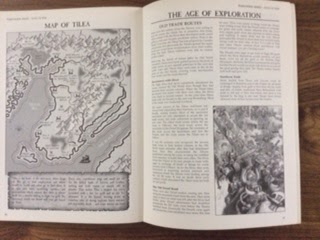
In fact, Dogs of War is my favourite Army Book. It doesn't really matter how good, say, the Elf or Dwarf Army Books might be, as the material is so familiar, having been recycled and regurgitated so many times through each edition of the game. And the Empire? Well, any WFRP GM has better material detailing the Empire than he or she might find in an Empire Army Book. And that is even if I were to cleave to a higher fantasy conception of the Warhammer world than that of The Enemy Within. But Dogs of War? In Dogs of War I can find bits and pieces about the lands beyond the Empire, about Tilea, Estalia and beyond. There is so little 'official' material about these places; Brian Craig's Zaragoz, a brief mention in the WFRP1e rulebook's World Guide, a bit of material in the WFRP2e Companion, and so on, but where else? Dogs of War fills in a few of the gaps, and provides the bones, or at least a sketchy outline, of something that I, as GM, can fill.
The background of each regiment (not all of which are Tilean - there are details on Golfag's Ogres, Long Drong Slayer's Pirates, Al Muktar's Desert Dogs, &c.) and is full of small details that could easily be incorporated into a WFRP game:
The fact that Dogs of War regiments are accompanied by all manner of 'special characters', not all of which are wham-bam! heroes or wizards, means that the book contains the foundations of very interesting and colourful NPCs - possibly patrons to the adventurers; the genius Leonardo da Miragliano (and his 'scientific' items), Lucrezzia Belladonna, a ruthless, politically powerful sorceress, Marco Columbo, 'discoverer' of Lustria, &c.
The history and social structure of Tilea is also discussed - and a timeline is provided - which, as the Tileans are notable explorers, includes passing discussion of other parts of the Warhammer world.
Of course, there are WFRP community developed resources detailing the world beyond the Empire, but more of that another time.
p.s. I notice that, in Dogs of War, Games Workshop asserts that such pre-existing terms as Grail Knight, Knight Errant, and, laughably, Skink, are Trademarks. In the contemporaneous Brettonia book, GW make the same claim for Chivalry!